

- About Us
-
Space delivers data-driven insights, streamlined processes, and exceptional user experiences that drive success through services like data analytics, Generative AI, Generative AI, process automation, and UX/UI design.
Empower your teams to make smarter decisions.
Gain a competitive edge and optimize your business.

Witness the impact of our AI service on a business's success.


Streamline your data processes for maximum efficiency.

Elevate your brand with our innovative designs.

Witness the impact of our AI service on a business's success.

Maximize product impact with our dedicated management services.

Achieve your project goals with our expert support Team.
-
Space partners with businesses across a wide range of industries to optimize operations and drive success through data-driven insights and streamlined processes.
Explore our industry solutions and discover how we can help your business thrive.
 Healthcare
  Education
  Banking
  Manufacturing
  Finance
  Insurance
  Transportation and Logistics
  Construction


 Global
 Global
  India
India  UAE
UAE  USA
USA 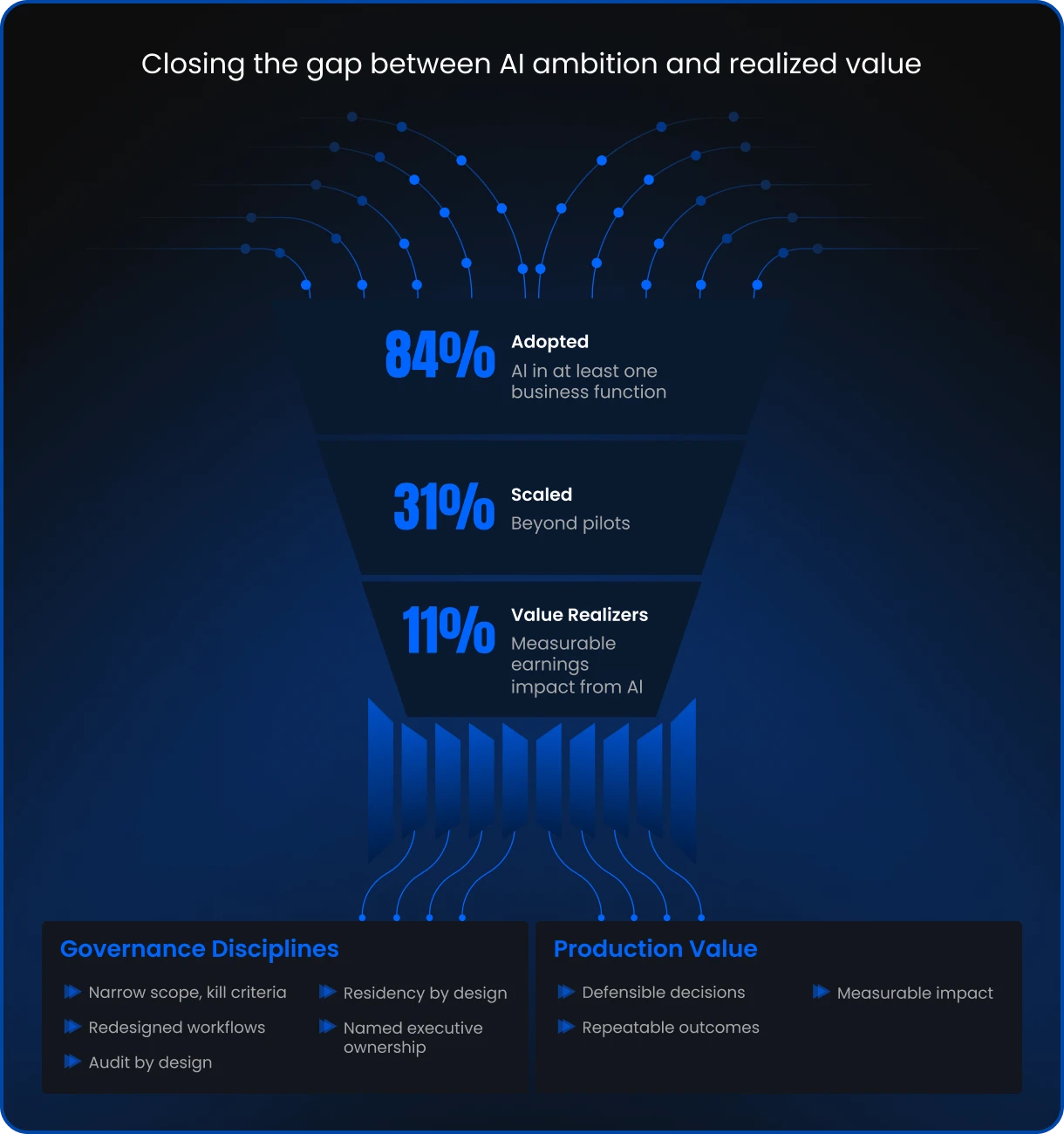
Table of Contents
The governance dividend
- At a glance
- The conversion gap, in numbers
- Reading the failure statistics like an operator
- What the value realizers do differently
- Three obligations that make the Gulf different
- The governance dividend
- Life sciences wrote the rule-book first
- The Monday morning test
- A two-year window
- Sources and notes


At a glance
- The UAE is the first economy where more than 70 percent of working-age people use AI, yet only 11 percent of GCC organizations can attribute measurable earnings to it (Microsoft, McKinsey, 2025 to 2026).
- The binding constraint has moved from model quality to operating model: 42 percent of companies abandoned most AI initiatives in 2025, and every leading cause of failure is organizational, not technical.
- The Gulf's distinct obligations, data residency, deployer accountability and procurement seals, force exactly the disciplines that separate value realizers from pilot purgatory. We call this the governance dividend.
- 2025 rewrote the rulebook for AI in regulated production: FDA guidance, the ISPE GAMP AI guide and the EU's draft Annex 22 all point to the same architecture the winners already build.
By early 2026, the United Arab Emirates had become the first economy in the world where more than 70 percent of the working-age population uses AI, against a global average of 17.8 percent, according to Microsoft's AI Economy Institute. Across the GCC, 84 percent of organizations have now adopted AI in at least one business function, four points behind the global figure and closing fast, per McKinsey's November 2025 regional survey. The adoption race, the one most conference keynotes are still narrating, is over. This region won it.
Then comes the second set of numbers, the ones that rarely make a keynote. In the same McKinsey survey, 31 percent of GCC organizations report scaling AI beyond pilots. Just 11 percent qualify as what McKinsey calls value realizers: organizations that can attribute measurable earnings impact to AI. The region that adopted faster than almost anyone now stands at the same wall as everyone else: converting usage into production, and production into profit and loss.
I have spent my career on the production side of that wall, building and shipping AI systems inside GxP-regulated environments, where a model that cannot survive an audit does not ship at all. From that side, the Gulf's conversion gap looks different from the way it is usually discussed. The obstacle is not talent, capital or ambition; the region has all three in abundance. And the famously demanding regulatory environment is not the obstacle either. Read correctly, it is the closest thing to a published solution this industry has.
Adoption is a decision. Production is a discipline.
The conversion gap, in numbers
The pattern is global before it is regional. McKinsey's State of AI survey of 1,993 organizations across roughly 105 countries found 88 percent using AI in at least one function in 2025, while only 7 percent had fully scaled it across the enterprise. Between those two figures sits the widest gap between investment and realized return in modern enterprise technology. The GCC's funnel is marginally healthier at the top and no healthier where it counts.
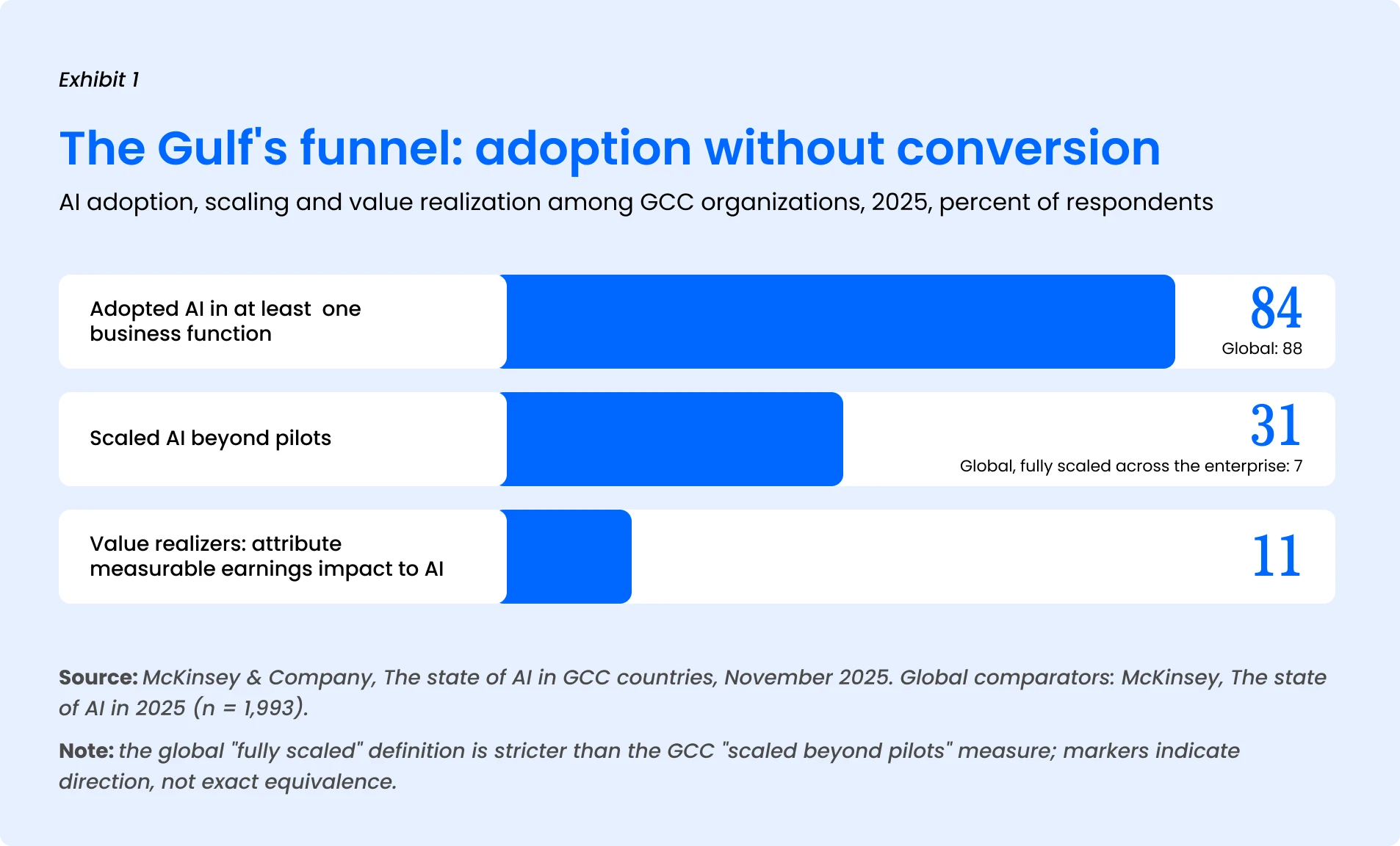
Two readings of Exhibit 1 are common, and both are wrong. The pessimist reads it as proof that enterprise AI does not work. The optimist reads it as a maturity curve that time will fix on its own. The operator's reading is different: the funnel narrows exactly where deployment discipline runs out, and discipline, unlike time, is a choice.
Reading the failure statistics like an operator
The most quoted number of 2025, MIT Project NANDA's finding that 95 percent of generative AI pilots produced no measurable profit-and-loss impact, deserves more care than it usually receives. It was a preliminary working paper; its own authors described the figure as directional, and the same study showed vendor-partnered deployments reaching production roughly twice as often as internally built tools. Quote it as a headline and you learn nothing. Read it as an operator and one detail stands out: the failures clustered where organizations built without deployment discipline, not where the models were weak.
The better-sourced numbers are less quotable and more useful. S&P Global Market Intelligence found the share of companies abandoning most of their AI initiatives jumped from 17 percent in 2024 to 42 percent in 2025, with the average organization scrapping 46 percent of its proofs of concept before production. Informatica's survey of 600 chief data officers found 43 percent naming data quality and readiness as the top obstacle between pilots and the finish line. And Gartner now predicts that more than 40 percent of agentic AI projects will be canceled by the end of 2027, citing escalating costs, unclear business value and inadequate risk controls, while cautioning that of the thousands of vendors claiming agentic capability, only about 130 offer the real thing.
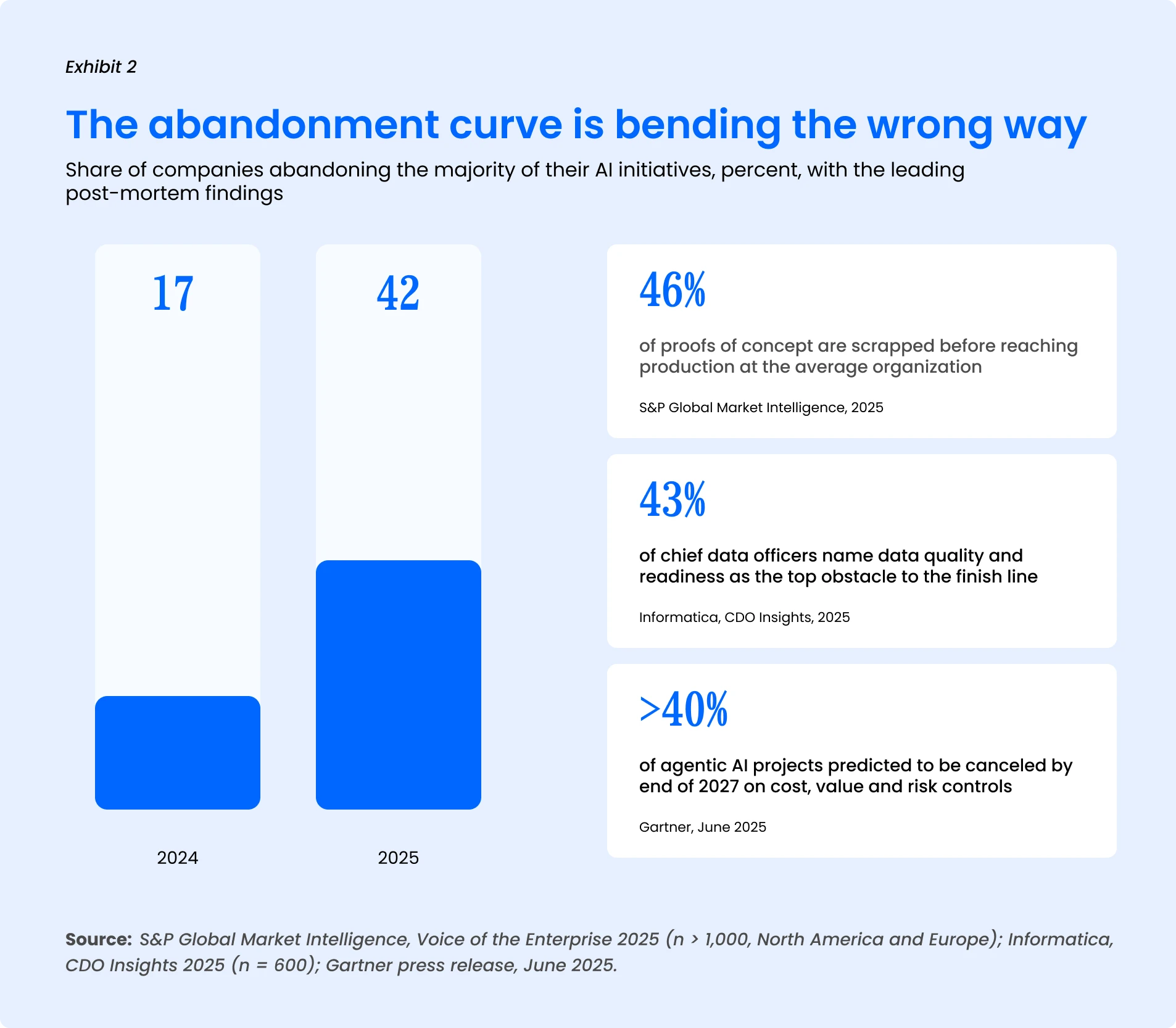
Line these post-mortems up and the pattern is hard to miss. Escalating cost is a scoping failure. Unclear value is a missing success criterion. Data readiness is an architecture decision that was deferred. Inadequate risk controls are governance that was never designed in. Every named cause of death is an operating-model cause. None of them is a model cause. The industry keeps upgrading the engine while the vehicle has no chassis.
A working definition: pilot debt
The accumulated cost of retrofitting governance onto a system built without it: re-architecting for data residency, reconstructing audit trails, re-validating against an intended use that was never written down. Like technical debt, it compounds quietly, and it comes due at compliance review. The 42 percent abandonment rate is what pilot debt looks like at scale.
What the value realizers do differently
The same surveys that count the failures also profile the exceptions, and two findings tower over the rest. McKinsey's high performers, the organizations attributing meaningful earnings impact to AI, are 2.8 times more likely than their peers to have fundamentally redesigned workflows as they deployed, rather than bolting a model onto an unchanged process. And at large companies, no factor correlated more strongly with bottom-line impact than CEO-level oversight of AI governance. Not the size of the model budget. Not the number of use cases. The seniority of the person accountable for governing them.
Field experience fills in the rest of the profile. The teams I have watched reach production share three further habits: they scope each initiative to a single workflow with pre-agreed acceptance criteria and, just as important, pre-agreed kill criteria; they build observability and the audit trail into the first prototype rather than retrofitting them before go-live; and they decide where data will physically live before deciding what the system will do. Five disciplines, then: narrow scope, redesigned workflow, audit by design, residency by design, named ownership. Hold that list. It is about to reappear somewhere unexpected.
Three obligations that make the Gulf different
Most markets face some version of the governance challenge. The Gulf adds obligations that genuinely do not exist elsewhere, and they reshape architecture before a single model is selected.
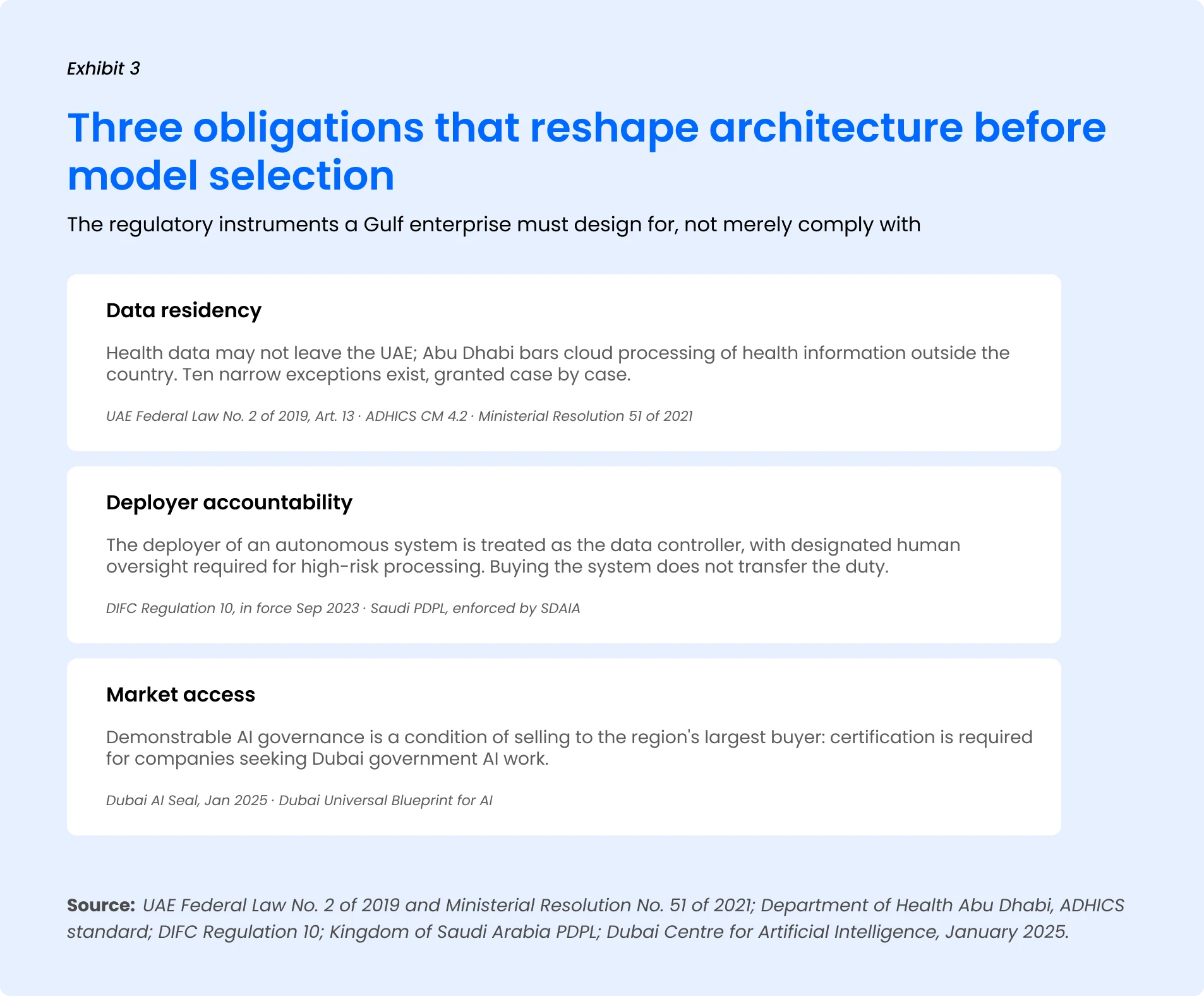
Data residency is the sharpest of the three. UAE Federal Law No. 2 of 2019 restricts health data from leaving the country, and Abu Dhabi's ADHICS standard goes further, barring healthcare entities from using cloud infrastructure outside the UAE to store, process or transmit health information. Ministerial Resolution 51 of 2021 carved out ten narrow, case-by-case exceptions for situations such as pharmacovigilance reporting and clinical trials. A global GenAI stack that assumes data can move to a US or EU region is not merely suboptimal here. It is undeployable, and it stalls at exactly the compliance review where nearly half of all proofs of concept already die.
Accountability is the second. In the DIFC, Regulation 10, in force since September 2023 with full enforcement from January 2026, treats the deployer of an autonomous system as the data controller and requires designated oversight for high-risk processing. Saudi Arabia's Personal Data Protection Law, now actively enforced by SDAIA, adds strict cross-border transfer controls and consent requirements around solely automated decisions. The third obligation is market access itself: Dubai's AI Seal, launched in January 2025 under the Dubai Universal Blueprint for AI, is required of companies seeking Dubai government AI work. In this market, demonstrable governance is not just risk management. It is the price of admission to the largest buyer in the economy.
The governance dividend
Now set the two lists side by side: the five disciplines the global evidence rewards, and the obligations this region imposes. They are the same list.
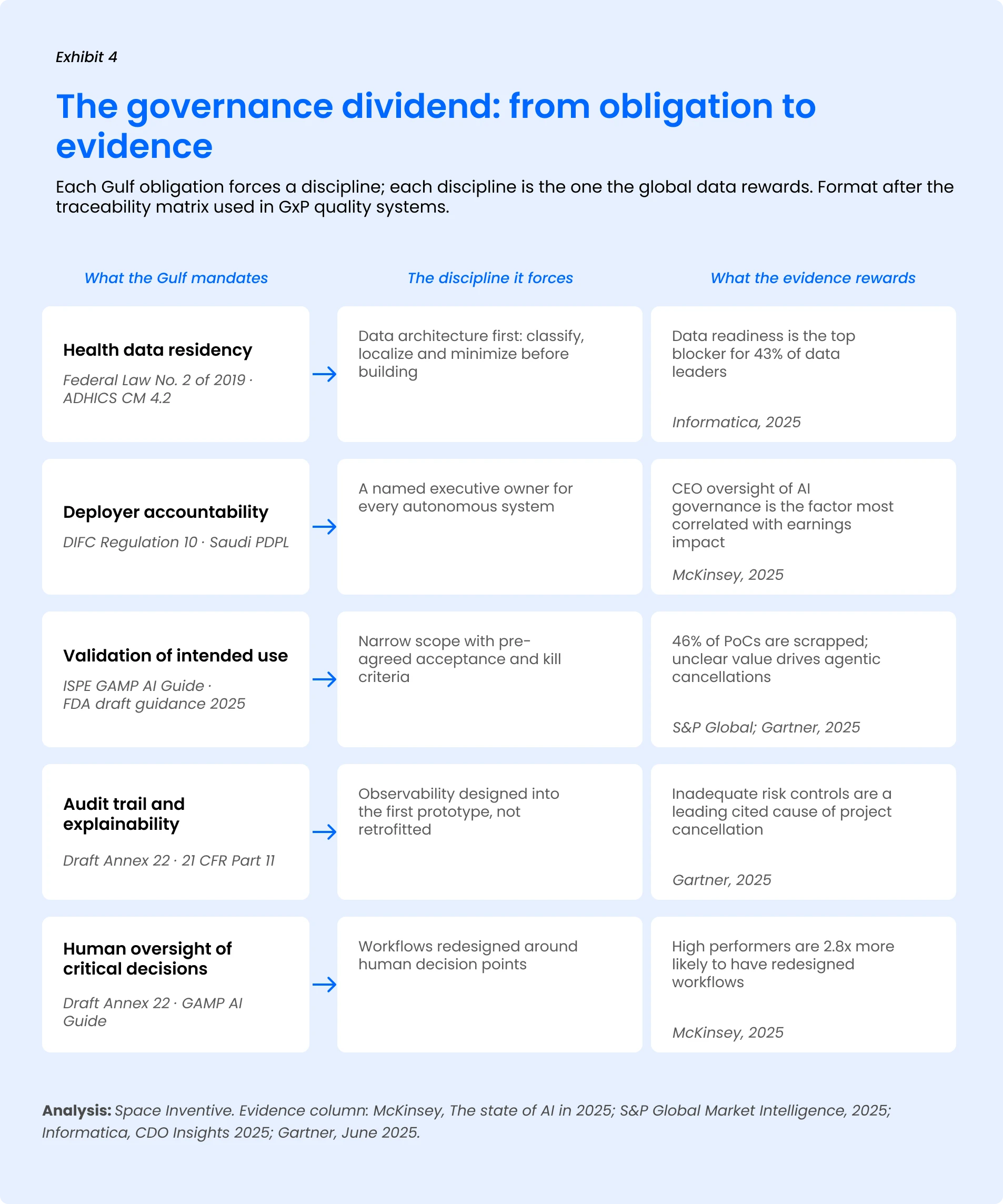
This is the argument of this essay, and as far as I can tell it has not been made plainly anywhere: the Gulf's regulatory specificity, treated as an input to architecture rather than a hurdle before launch, installs precisely the operating model that separates the 11 percent from the rest. Elsewhere, the five disciplines are voluntary, which is a large part of why only 7 percent of organizations globally reach full scale. Here, four of the five are written into law, standards or procurement. The region did not just adopt AI faster than its peers. It legislated the success factors, mostly before the technology arrived.
Governance is not the toll booth on the road to production. In this region, it is the road.
I call the resulting advantage the governance dividend, and one caution keeps it honest: a dividend is not a gift. Obligations ignored until go-live pay out as pilot debt, not dividend; the 42 percent abandonment rate is what that looks like at scale. The dividend accrues only to enterprises that architect for the obligations from the first sprint. The distance between those two outcomes, debt and dividend, is where the next two years of regional competition will be decided.
Life sciences wrote the rule-book first
If the thesis holds anywhere, it must hold in pharmaceutical and healthcare production, the most regulated deployment surface AI has. 2025 was the year that rulebook was written down.
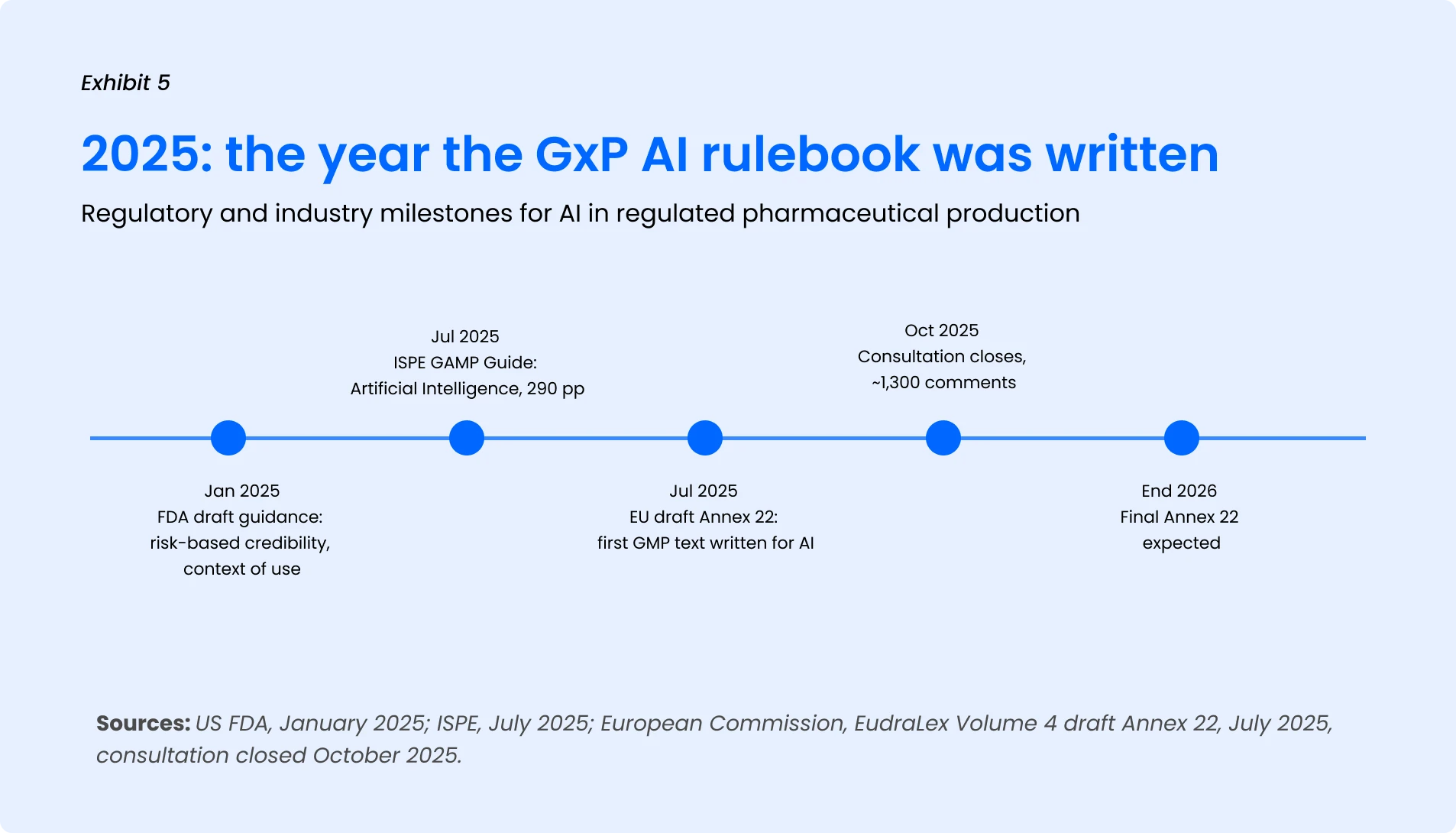
In January 2025 the US FDA issued its first draft guidance on AI in drug and biological products, built around a risk-based credibility assessment tied to each model's context of use. In July, ISPE published its GAMP Guide on Artificial Intelligence, 290 pages and the industry's first dedicated framework for AI in GxP environments. The same month, the European Commission released draft Annex 22 to the EU GMP guide, the first GMP text written specifically for AI; the consultation closed in October with roughly 1,300 comments, and a final version is expected by the end of 2026.
Annex 22's most consequential line is a boundary, not a ban: dynamic, probabilistic models, the category that includes today's generative and large language models, should not operate critical GMP applications. Deterministic, validated, supervised systems where product quality is at stake; generative systems where a qualified human holds the pen. That is not regulators misunderstanding the technology. That is regulators describing, with unusual clarity, the same human-in-the-loop architecture the value realizers already build.
The manufacturers scaling fastest confirm it. Roche reports that AI in its biologics operations is past pilot purgatory and delivering 5 to 10 percent yield improvements, up to 50 percent reductions in critical quality attribute write-offs, and 30 to 50 percent time savings in deviation management. AstraZeneca runs dozens of AI use cases across a plant network that includes World Economic Forum Lighthouse sites. In both cases the pattern is identical: validation discipline first, model sophistication second.
The Monday morning test
Frameworks are cheap; Monday morning is expensive. These are the five questions I would put to any Gulf executive team that believes its AI program is on track. Each maps to one row of Exhibit 4, and each has a wrong answer that predicts the program's future with uncomfortable accuracy.
1.
Where, physically, does the data behind your most advanced pilot reside, and can you prove it to an auditor this week?
If the answer involves checking with the vendor, the residency decision has already been made for you.
2.
Which named executive owns AI governance, and would they describe themselves that way?
A committee is not an owner. The data says the seniority of this one name moves the earnings needle.
3.
What pre-agreed result would kill the pilot?
If nothing can kill it, it is not a pilot. It is a demo with a budget, and it will join the 46 percent.
4.
If a regulator asked why the system made a specific decision last Tuesday, how many days would the answer take?
The honest unit of measurement here is the difference between an audit trail and an archaeology project.
5.
Which human can override the system, and is that authority in the workflow or only in the slideware?
Draft Annex 22 will ask a version of this question formally. Better to have the answer before it does.
A two-year window
The Gulf's sovereign investments mean compute, capital and national models will not be the constraint; conversion will be. The enterprises that bank the governance dividend between now and 2028 will set the reference architectures that everyone else in the region licenses, audits against, or loses deals to. Those that keep accumulating pilot debt will discover that in regulated sectors, the market shares the auditor's memory.
This conviction is why Space Inventive established its UAE subsidiary in Dubai this year, as a regional base for governed, production-grade AI in regulated industries. But the window belongs to the market, not to any one firm. Adoption is a decision, and this region has made it emphatically. Production is a discipline. The discipline is the opportunity.
Hemant Kumar Mahato is Principal AI Solution Architect & Regional Head-UAE, at Space Inventive. His delivery work spans agentic workflow automation and compliance-embedded AI systems in GxP-regulated pharmaceutical and life sciences environments.
This perspective draws on published research and primary regulatory texts from Microsoft, McKinsey, S&P Global Market Intelligence, Informatica, Gartner, MIT, ISPE, the European Commission, the US FDA, and UAE, DIFC and Saudi authorities, read against the author's delivery experience. All figures are attributed inline; full sources below.
Sources and notes
- Microsoft AI Economy Institute. Global AI adoption reports. January 2026 and May 2026. Global AI Diffusion in Q1 2026 - AI Economy Institute | Microsoft
- McKinsey & Company. The state of AI in GCC countries: in pursuit of scale and value. November 2025. https://www.mckinsey.com/capabilities/quantumblack/our-insights/the-state-of-ai-in-gcc-countries-in...
- McKinsey & Company. The state of AI in 2025: agents, innovation, and transformation. November 2025. n = 1,993 across ~105 countries. https://www.mckinsey.com/capabilities/quantumblack/our-insights/the-state-of-ai
- S&P Global Market Intelligence. Voice of the Enterprise: AI and machine learning, use cases 2025. n > 1,000, North America and Europe. Coverage via CIO Dive. AI project failure rates are on the rise: report | CIO Dive
- Informatica. CDO Insights 2025. January 2025. n = 600 chief data officers. CDO Insights 2025 – global data leaders racing ahead, despite headwinds to being AI ready, latest su…
- Gartner. Press release: over 40 percent of agentic AI projects will be canceled by end of 2027. June 2025. https://www.gartner.com/en/newsroom/press-releases/2025-06-25-gartner-predicts-over-40-percent-of-a...
- MIT Project NANDA. The GenAI divide: state of AI in business 2025. Preliminary working paper, July 2025. Figures described by the authors as directional. Coverage via Fortune. MIT report: 95% of generative AI pilots at companies are failing | Fortune
- UAE Federal Law No. 2 of 2019 on the use of ICT in health fields; Ministerial Resolution No. 51 of 2021. United Arab Emirates Regulations Limit Cross Border Health Data Flows
- Department of Health Abu Dhabi. ADHICS: Abu Dhabi healthcare information and cyber security standard, section CM 4.2. Covered by the trade.gov reference above.
- DIFC. Regulation 10: processing personal data through autonomous and semi-autonomous systems. In force September 2023; full enforcement January 2026. https://www.difc.com/business/registrars-and-commissioners/commissioner-of-data-protection/regulation-10
- Kingdom of Saudi Arabia. Personal Data Protection Law; SDAIA AI ethics principles. https://sdaia.gov.sa/en/SDAIA/about/Pages/RegulationsAndPolicies.aspx
- Dubai Centre for Artificial Intelligence. Dubai AI Seal, under the Dubai Universal Blueprint for AI. January 2025. https://www.protocol.dubai.ae/en/media-listing/news-events/dubai-centre-for-artificial-intelligence...
- ISPE. GAMP guide: artificial intelligence. July 2025. ISPE GAMP® Guide: Artificial Intelligence | ISPE | International Society for Pharmaceutical Engineer…
- European Commission. Draft Annex 22, EudraLex Volume 4: artificial intelligence. July 2025; consultation closed October 2025. EU GMP Annex 22 (Draft 2025): Artificial Intelligence - ECA Academy
- US FDA. Draft guidance: considerations for the use of artificial intelligence to support regulatory decision-making for drug and biological products. January 2025. Federal Register :: Considerations for the Use of Artificial Intelligence To Support Regulatory Deci…
- BioProcess Online, on AI in pharma technical operations at Roche; World Economic Forum, Global Lighthouse Network, 2024. AI Breakthroughs Revolutionizing Pharma Tech Ops At Roche How AI is transforming the factory floor
Read More

By Hemant Kumar Mahato
Principal AI Solution Architect & Regional Head, UAE
Read other blogs
Your go-to resource for IT knowledge. Explore our blog for practical advice and industry updates.
-

-
-

Understanding
Global Tariff
Conversations: Origins, Definitions, and
Economic ImplicationsRead Blog -

Discover valuable insights and expert advice.
Uncover valuable insights and stay ahead of the curve by subscribing to our newsletter.

Download Our Latest Industry Report
To know more insights!